Market Overview – Third quarter 2026
Market commentary
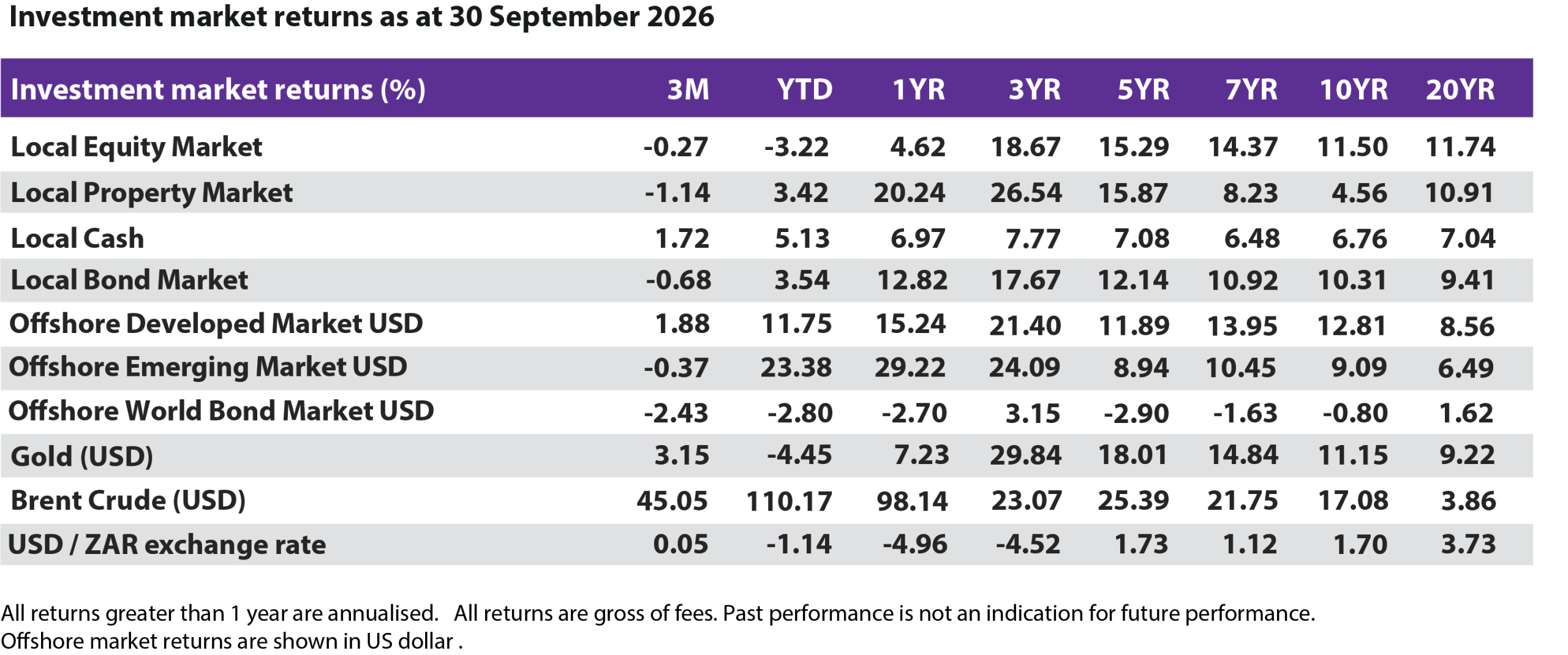
Global equities produced mixed results during the third quarter of 2026, with conditions becoming increasingly challenging for bond markets. Geopolitical tension disrupted Middle Eastern energy supplies, pushing oil prices and inflation expectations higher. At the same time, sizeable fiscal deficits and strong demand for capital to fund Artificial Intelligence (AI) infrastructure contributed to rising global bond yields. Surprising economic activity and corporate earnings supported developed-market equities, creating a quarter in which global equities advanced modestly while bonds and other interest-rate-sensitive assets came under pressure.
-
Local Growth Assets:
South African equities shed -0.3% over the quarter after gains in July and August were reversed by a sharp September sell-off. Precious metal miners, Naspers and Prosus were among the largest detractors, while consumer-facing companies also came under pressure as household finances remained constrained. The uneven result again highlighted concentration risk within the local market with movements in a relatively small number of large resource and technology-linked counters having a disproportionate effect on the headline index.
-
Local defensive assets:
Local cash (+1.7%) continued to provide a positive nominal return, while domestic bonds (-0.7%) weakened toward quarter-end as global yields and inflation expectations rose. The South African 10-year government bond yield moved above +9%, reflecting both the international bond
sell-off and a more demanding domestic inflation outlook. Whilst higher yields do create short-term capital volatility, they also improve the prospective income available to long-term investors. Fixed-income returns are nevertheless likely to remain sensitive to oil prices, fiscal risks and the path of monetary policy. -
Global rate and inflation cycle:
South Africa’s economy contracted by -0.2% in the second quarter, ending six consecutive quarters of expansion and prompting the South African Reserve Bank (SARB) to lower its 2026 growth forecast to +1.2%. Headline inflation rose to +4.4% in August, above the SARB’s +3% target, as renewed fuel-price pressure complicated the outlook. In September, the SARB raised the repo rate by +0.25 percentage points to +7.25%. The Bank expects inflation to move above +5% later in 2026 before easing as the fuel shock is anticipated to recede, leaving future policy decisions highly dependent on incoming data.
-
Offshore Developed Equity Markets:
Developed-market equities delivered a positive +1.9% USD quarter despite higher energy prices and rising bond yields. Resilient economic activity, healthy corporate earnings and continued investment across the AI value chain supported sentiment, with the US market remaining an important contributor. However, leadership was selective and valuations in several technology-related segments remained elevated. The long-term investment case for AI therefore remains constructive, but concentrated positioning and demanding earnings expectations increase the risk of short-term volatility.
-
Offshore Emerging Equity Markets:
Emerging-market equities declined -0.4% USD during the quarter, lagging developed equity markets. Weakness in parts of North Asia, including semiconductor and technology shares in Taiwan and South Korea, offset firmer performance elsewhere. These markets retain meaningful exposure to long-term growth in AI infrastructure, but their concentration in a narrow group of large technology companies can amplify volatility when expectations for earnings, capital expenditure or regulation change.
-
Exchange rate and commodities:
The rand was broadly strengthened by +1.1% against the dollar over the quarter, supported by comparatively attractive local interest rates and periods of commodity-price strength. Energy prices rose as the Middle East conflict disrupted supply routes, while precious metals weakened sharply in September after strong gains earlier in the quarter. For South African investors, currency movements detracted from offshore returns placing more emphasis on the performance of the underlying global assets. This reinforces the role of offshore exposure as a source of long-term diversification rather than a short-term currency trade.
GTC’s portfolios remain positioned with a long-term, risk-aware investment approach. The third quarter demonstrated that durable growth and earnings can support equity markets even when inflation, geopolitical risk and rising yields create a less favourable environment for bonds and other interest-rate-sensitive assets. It also showed how quickly concentrated market leadership can be reversed, both locally and offshore.
GTC maintains a cautiously optimistic and diversified portfolio stance. Local and offshore growth assets continue to provide access to different return drivers, while defensive allocations can help moderate volatility and provide liquidity during periods of uncertainty. Clients should assess performance against the time horizon and objective of their portfolio rather than against a single quarter and should avoid making allocation changes in response to short-term market or geopolitical developments. Remaining invested in line with the originally identified risk and return objectives remains the most appropriate course for long-term investors.