
Market Overview – Fourth quarter 2025
Market commentary
Change remains the one constant in markets – and the past year has provided a fresh reminder. Global tech has surged, resources have powered a strong local recovery, while shifting interest rate and trade decisions continue to ensure investors remain alert. Notable investment market developments over the course of 2025 include:
-
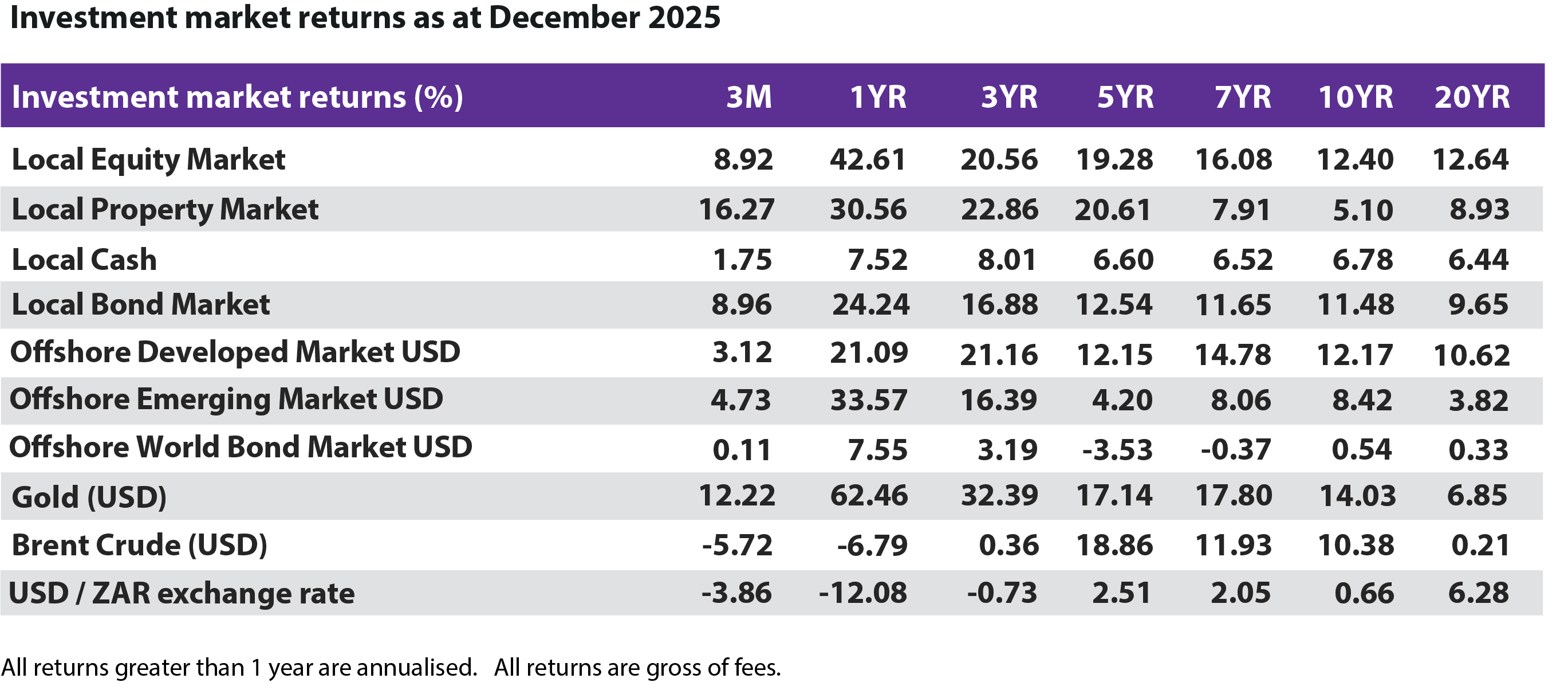
Local Growth Assets: The broad-based local equity market ended the quarter up +8.1% supported by broad-based gains across most sectors. The Financials sector led with gains of +19.0%, the Listed Property sector delivered +16.3%, followed by the Resources sectors +10.3% while the Industrials sector shed -1.2% for the quarter. Gold and Platinum counters gained triple digit returns over the year as the underlying commodity prices continued to run amidst sustained global demand.
Over the year the Resources sector delivered a remarkable +144.2% on the back of a continued rally in precious metals pricing, with the listed Property sector up +30.6%, the Financials sector +27.1% and the Industrials sector up +18.1%. This pushed the broader equity market up +42.6% for the full year.
-
Local defensive assets: Amidst interest rate cuts, and more importantly local yield compression, local cash returned a conventional +1.8% and +7.5% for the quarter and year respectively, well below local bonds, over the same periods. Bonds returned +9.0% and +24.2% over these perspective periods. The South African Reserve Bank (SARB) cut the repo rate by 100 basis points (1.0%) to 6.75% over the year. South Africa’s removal from the Financial Action Task Force (FATF) ‘grey list’ lifted investor sentiment and supported foreign inflows over the past few months.
-
US policy uncertainty: The Trump-led US administration’s focus on an ‘America First’ policy, particularly the announcement and implementation, throughout 2025, of significant tariffs on goods from countries such as China, Mexico, and Canada, became a major source of global market uncertainty. The escalation of geological interference by the US on countries such as Venezuela, Greenland and Iran further stoked investor fears of slow economic growth and stagflation risks. US equities lagging peer developed equity markets by 14% USD on average over 2025.
-
Global rate cuts: In contrast to the US FED, the European Central Bank (ECB) and the Bank of England (BoE) began cutting interest rates in the first quarter to support growth, as did several Emerging Market (EM) central banks. The ECB ended 2025 with interest rates at 2.0% amid a docile inflation rate. The US Federal Reserve had lowered interest rates by 75 basis points to 3.75%, over the course of the year, amidst US presidential pressure to lower rates further and faster .
-
Offshore Developed Equity Markets: The MSCI World Index earned +3.1% USD for the quarter and +21.1% USD for the year. After factoring in the USD weakness, this return reverted to +9.0% in rands over the year. The US equity market delivered less than +6% ZAR for the year. The Developed Equity market index excluding the US market, outperformed the US equity market by some +14% USD over the year amid concentration and valuation concerns around US tech companies. The beneficiaries were stocks with a relatively better valuation, driving up stock prices of companies in counties such as Japan, Germany and France.
-
Offshore Emerging Equity Markets: The MSCI Emerging Markets Index earned +4.7% USD for the quarter and +33.6% USD for the year, outperforming its developed market counterpart. This was largely driven by strong performance from Korea and Taiwan. The Korean equity market – the strongest performing Emerging Equity market – benefited from artificial intelligence (AI)-related technology demand, strength in industrials and the announcement of a new trade deal with the US. Taiwan continued to gain from ongoing investor demand for AI-related technology stocks. China’s anti-involution policy which aims to restore profitability, improve product quality, and manage overcapacity positively impacted market sentiment as well.
-
Exchange rate and commodities: The USD weakened -3.9% relative to the rand over the quarter to R16.56, and some -12% for the year amidst US specific risk factors. Gold continued its upward rally, gaining some +62.5% over the 12 months, closing the year at $4381/oz. Silver gained 133% for the year, closing 2025 at $70/oz.
Over this reporting period GTC’s portfolios were well-positioned to capitalise on the recent robust performance of both local and international equity and bond markets. While always welcome, we suggest that this impressive 43% return from local equities over one year more likely represents a mean reversion from previous periods of market underperformance?
We caution that this return exceeds typical long-term expectations. Consequently, a phase of more subdued short-term returns could reasonably follow as part of normal market fluctuations. GTC is therefore maintaining a cautiously optimistic approach to portfolio positioning as we navigate the current market environment.