




The Magnificent Seven: Is your global portfolio really diversified?
When seven American companies represent more than one-fifth of global equities, is international diversification becoming an illusion? Or is following the technology trend more important than spreading investment risk? If you own an international equity unit trust, an S&P 500 ETF and perhaps a Nasdaq-linked investment, congratulations. You’ve probably diversified your investment statements considerably. Your underlying investments? Perhaps not nearly as much as you think.
Seven American companies – Apple, Microsoft, Nvidia, Amazon, Alphabet (Google), Meta (Facebook) and Tesla – collectively known as the Magnificent Seven, have become so dominant that their influence is reshaping the very concept of international investment diversification. Their extraordinary performance has created enormous wealth for investors. But it raises an increasingly important question: At what point does participating in a successful investment trend become an unacceptable concentration of risk?
Seven companies, enormous influence
Consider three statistics that every international investor should understand. The Magnificent Seven collectively represent approximately:
- 34% of the S&P 500 Index.
- 21% of the MSCI All Country World Index (ACWI).
 One-third of American equity market capitalisation, with American equities themselves representing approximately 64% of global equities. These are extraordinary concentrations. The MSCI ACWI comprises approximately 2 400 companies across developed and emerging markets, yet seven businesses account for more than one-fifth of its value.
Consider an investor with R5 million allocated to a conventional global equity portfolio tracking the MSCI ACWI. Without specifically selecting any of these businesses, approximately R1.05 million is invested in just seven American companies. And if this investor also holds an S&P 500 or Nasdaq investment, their actual exposure could be considerably greater. Owning several differently named international unit trusts does not necessarily constitute diversification when the underlying investments overlap substantially.
Is global diversification becoming an illusion?
Traditional investment theory advocates diversification across countries, industries, currencies, asset classes and individual companies. The principle is straightforward. Different investments respond differently to economic circumstances, reducing the likelihood of one adverse event compromising an entire portfolio. However, most conventional equity indices are weighted according to the market capitalisation of their constituent companies.
As companies increase in value, their weighting within an index increases automatically. The index does not independently assess whether those companies have become expensive. This isn’t necessarily a weakness of passive investment management. It’s precisely how market-capitalisation-weighted investing operates.
Indexation means investors are allocating increasing proportions of their capital to companies that have already performed exceptionally well…
There is an important counterargument:
Although American companies represent almost two-thirds of the global equity market, they generate substantial revenues internationally. Apple’s customers, Microsoft’s software users and Amazon’s commercial operations are spread across numerous countries.
American corporate ownership does not necessarily mean exclusive exposure to the American economy. Nevertheless, geographical revenue diversification does not eliminate the risks associated with concentrated share ownership and valuations.
Technology versus diversification – which matters more?
Artificial intelligence, automation, robotics and digital infrastructure are fundamentally changing how businesses operate. These developments are not passing fashions, and investors who ignore them entirely could be making a significant mistake.
Importantly, the Magnificent Seven are not identical businesses. Tesla manufactures vehicles and energy-storage systems. Amazon operates retail and cloud-computing businesses. Alphabet generates substantial advertising revenue, while Nvidia supplies critical infrastructure supporting artificial intelligence. Their revenue streams and business models differ.
Whilst they’re different, they’re also similar. Several share important investment characteristics. Their valuations reflect substantial expectations of future earnings growth, and their fortunes are increasingly influenced by technological developments and investment in artificial intelligence.
The question isn’t whether these businesses will continue growing. It’s whether their share prices already anticipate too much of that growth. An excellent company can be a disappointing investment if purchased at an excessive valuation. Remember the technology boom of the late 1990s?
The internet unquestionably transformed the world. Investors who correctly anticipated this development were not necessarily rewarded if they purchased technology shares at valuations that subsequent earnings couldn’t justify. Being right about a technology trend isn’t necessarily the same as being right about an investment.
What happens when the Magnificent Seven become less magnificent?
History provides an interesting reality check. The Magnificent Seven collectively declined approximately 40% during 2022, compared with a 19% decline in the S&P 500. They subsequently recovered spectacularly, gaining approximately 76% in 2023 and 48% in 2024. Both the downside and upside are significant.
Concentration can generate extraordinary investment returns. Equally, it can produce substantial losses. For a younger investor accumulating retirement capital, significant volatility may be acceptable. For someone drawing regular income (say from a living annuity), the consequences of a substantial market correction could be far more serious. The same concentration can therefore be entirely appropriate for one investor and inappropriate for another.
Where should investors allocate capital if they reduce exposure?
Reducing exposure to the Magnificent Seven doesn’t require abandoning technology or American equities. Several alternatives warrant consideration. Broader American equities: An equal-weighted S&P 500 portfolio reduces the dominance of the largest companies. Mid-cap businesses and sectors such as healthcare, financial services and industrials also provide exposure to American economic growth.
Developed markets outside America: Europe, Japan and the United Kingdom offer opportunities in pharmaceuticals, manufacturing, industrial automation, financial services and consumer businesses, introducing different economic cycles and currencies.
Emerging markets: India, South Korea, Taiwan and other emerging economies provide exposure to different growth opportunities. However, replacing American technology companies with Asian semiconductor manufacturers may merely substitute one technology concentration for another.
Other asset classes: Government bonds, selected corporate debt, inflation-linked investments and cash can provide different return characteristics. For South Africans, rand-denominated assets may also be appropriate for meeting domestic expenditure requirements. The objective should be genuine diversification, not simply substituting one potentially fashionable investment for another.
How much exposure is too much?
There is no universally correct answer. An investor whose global equities contain approximately 21% in the Magnificent Seven is broadly reflecting prevailing global market weightings. That’s not automatically excessive. However, additional technology funds, individual shares and Nasdaq investments could produce considerably greater concentration than intended.
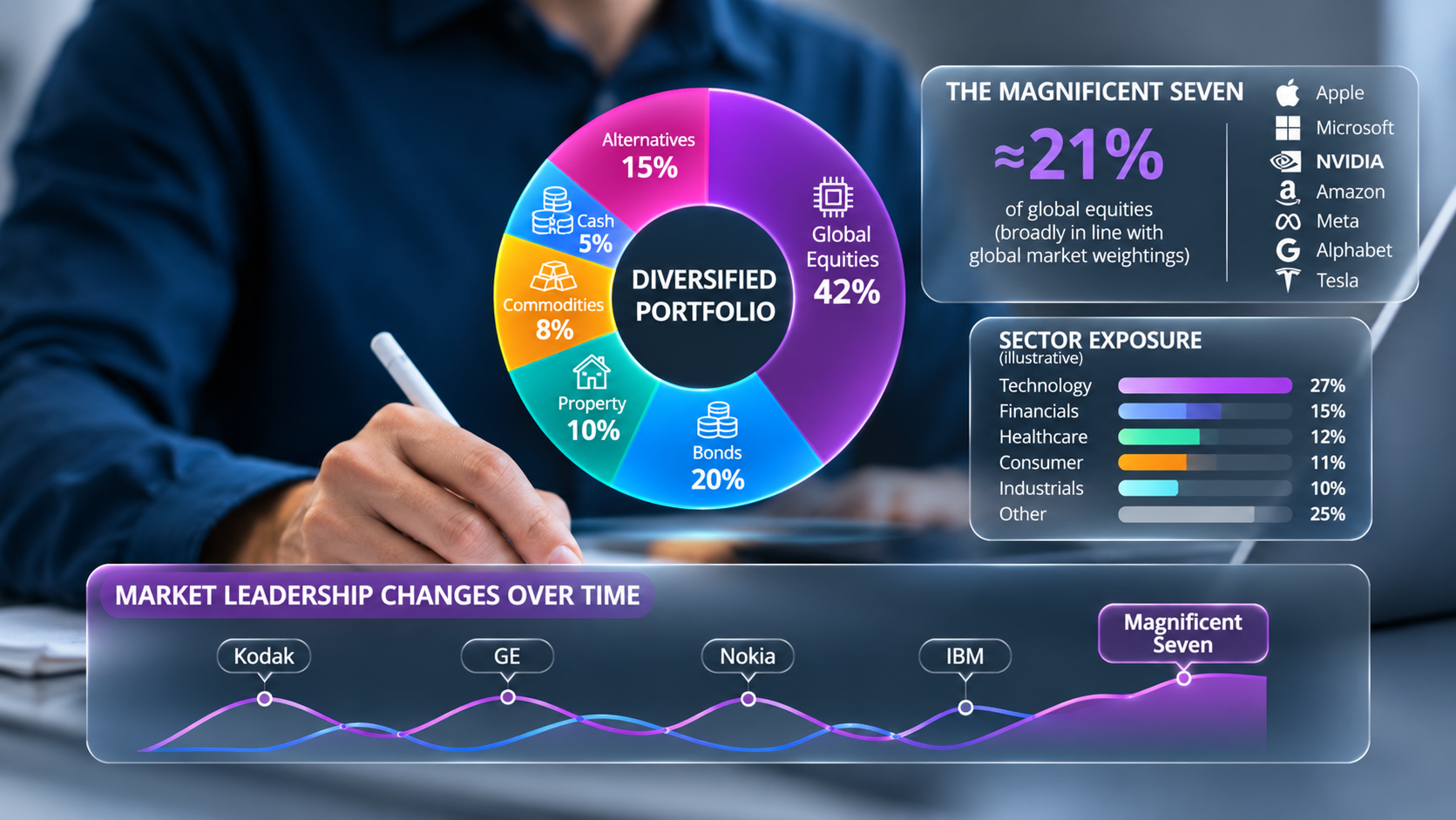 At GTC, we believe a comprehensive look-through analysis of the underlying investments is essential. Understanding actual company, sector, currency and geographical exposures provides a far more accurate picture than examining fund names alone. Any reallocation should consider valuations, transaction costs, potential tax consequences and the investor’s broader financial objectives. Don’t confuse participating in the future with betting everything on it.
The Magnificent Seven have earned their place among the world’s largest companies. Their achievements are extraordinary, their competitive advantages formidable, and their influence undeniable. They may remain dominant for many years. But history reminds us that market leadership changes, frequently when investors least expect it.
Remember Kodak, Nokia, General Electric and IBM? Each enjoyed periods when their dominance appeared almost unassailable.
GTC’s contention is that investors should participate in technological progress without allowing their financial security to become unnecessarily dependent upon it.
Diversification – by its very definition – means holding some investments that underperform the market leaders. Rather than being a failure of the strategy, that’s the price of reducing the consequences of being wrong.
Perhaps the most important question isn’t whether the Magnificent Seven are good investments. It’s whether your portfolio is sufficiently diversified to withstand a period when they no longer lead the market.


